
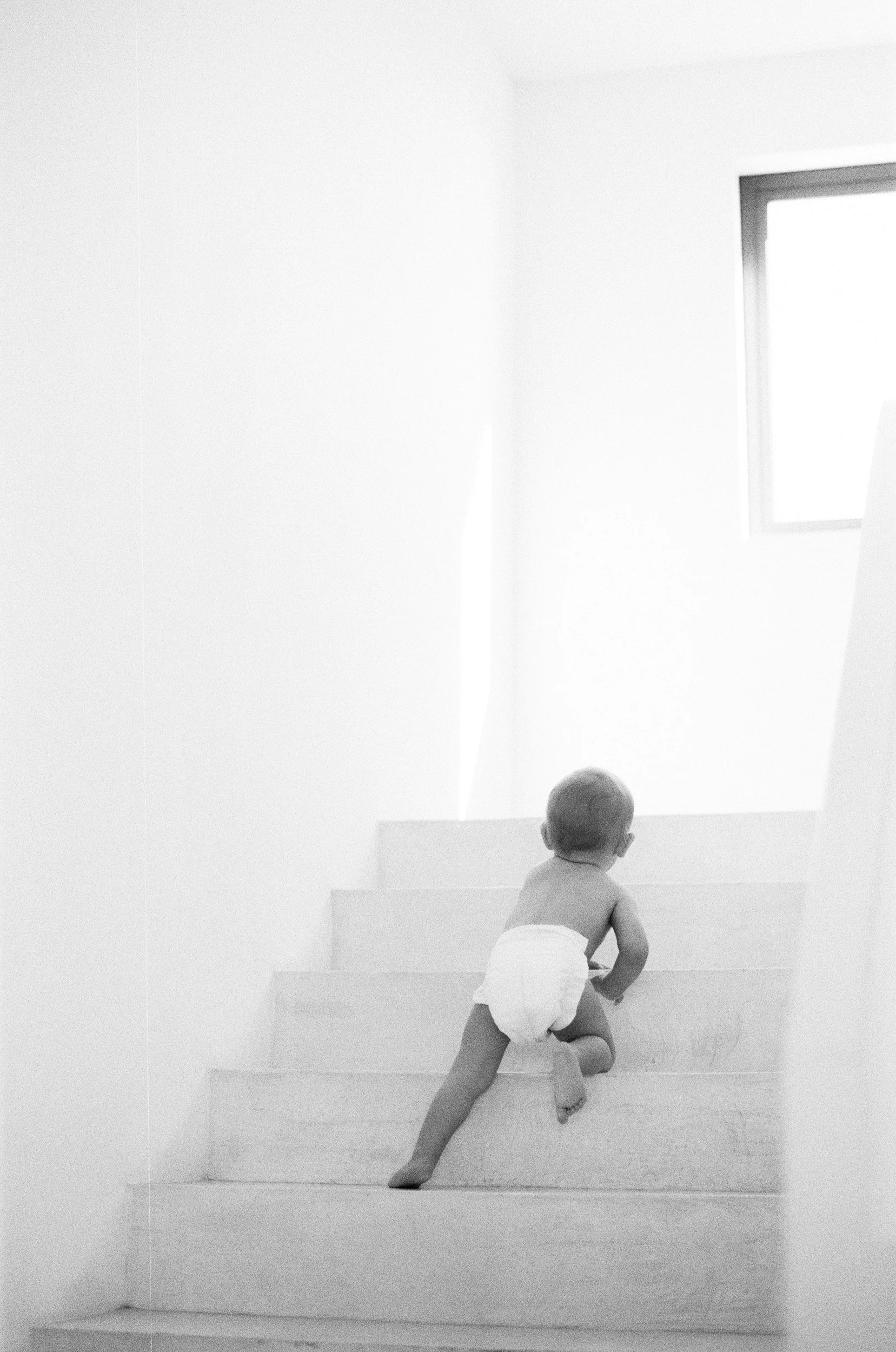
More about Motor Milestones
Did you ever stop to think about how we start developing our movement and body awareness in the womb? And once we are born, sensory-motor connections continue to grow through the first year of life with rapid expansion of motor skills progressing from involuntary and reflexive movements to independent and skilled mobility.
When working with babies and toddlers, my approach is focused on treating motor delays or dysfunctions from a brain’s perspective whether it’s a simple and straightforward delay, or something more complex. I start with analyzing why a skill hasn’t developed, or why movement is presenting differently.
Motor milestones serve as a predictable sequence of skill acquisition– rolling, crawling, walking. Parents wait with bated breath for the baby’s “first”s, but sometimes a baby will move differently or deviate from the normal sequence. This does not always indicate a problem. A delay in a milestone simply acts as a sign of a possible disturbance in the brain-body development.
What’s great about babies is that their brains are very plastic and are making 1 million new neural connections every second1! This makes it often easier to adjust the course of development early on, rather than waiting until challenges become set patterns.
Strength and mobility are not the only factors in motor development. For example, development of a baby’s head control relies on the development of the vestibular and visual righting systems. Understanding how all of the developing systems relate to each other is important to consider when assessing a motor delay and approaching therapy with a holistic approach.
Here is an example of how connected motor development is:
When a baby starts to explore independent sitting around 5 months old, an early strategy to maintain sitting is by leaning forward and retracting the shoulder blades. This utilizes the arms as part of the postural system to reinforce trunk stability in sitting. When the arms are tied to the postural system, it prevents functional use of the arms and hands. The arms and hands are positioned upwards and close to the body, which functionally pulls them away from toys, and away from their own body.
If we intervene here and support the baby’s trunk to provide that extra amount of support for that they are getting from theirs arms, we’ll see the baby can untie their arms from their postural system and now the baby can use their arms to reach for a toy, or bring their hands together, or touch their own body. By our intervention of giving external trunk support, we start to mimic what a baby will look like at 6 months when they have developed the trunk and hip strength for sitting more upright and freeing the arms and hands for reaching, object manipulation, and exploration.
This helps demonstrate how trunk stability is a necessary precursor for arm and hand development. So if a baby is having difficulty using their arms for reaching, crawling, or poor body awareness at 6+ months, we need to ask: is it because they are not able to control their arm, or is it because they need their arms to be part of their postural system to stay upright? Different reasons for the observed difficulty necessitates different treatment strategies.
There are so many facets of the developing infant and child and linking the pieces together can help us support developmental milestones.
When working with an older child with significantly delayed or missing motor milestones due to a neurological cause, we want to focus on the brain. These outcomes are based on how the brain is processing the information. We look to identify what the brain needs to learn in order to change the motor output.
It is important to address missing skills in an older child, but we don’t always need to follow the typical developmental sequence. We should consider working on motor skills that are age appropriate, and consider the child’s habits, perceptions, behaviors, and interests to encourage meaningful movement development.
Questions about your child’s motor milestones? Let’s connect!
1. Why 0 to 3? Explore Baby Brain Science. (August 24, 2022). https://www.zerotothree.org/why-0-3/
© 2026, Brenda Huey